Your e-bike battery is its most valuable single component and its most vulnerable. From theft prevention and safe charging to smart security tech, here is everything Australian riders need to know about keeping their battery safe.

If you own an e-bike, your battery is almost certainly the most expensive single component on it. Replacement batteries typically cost between $400 and $1,200, depending on the brand and capacity, and for premium systems like Bosch or Shimano, you could be looking at even more. It is also one of the easiest parts to steal. Many e-bike batteries are designed to be removable, which is great for charging but also makes them a target.
Then there is the fire risk. Lithium-ion battery fires have surged across Australia in recent years, prompting new regulations and genuine concern, especially among riders who live in apartments. This guide covers everything you need to know about protecting your e-bike battery: keeping it secure, charging it safely, and using the latest tech to your advantage.
E-bike batteries are attractive to thieves for a few reasons. They are compact, valuable, and easy to resell. Unlike stealing an entire bike, removing a battery can take just seconds if it is not properly secured. A thief does not need bolt cutters or angle grinders, just a key or, in some cases, a firm tug.
How to secure your battery against theft
The most effective defence is to remove the battery and take it with you - for example, if you are leaving your bike parked for an extended period. We know this is not always practical (most batteries weigh between 2.5 and 4 kg), so when it is not an option, the steps below will help reduce the risk.
When that is not practical, here are some other steps:
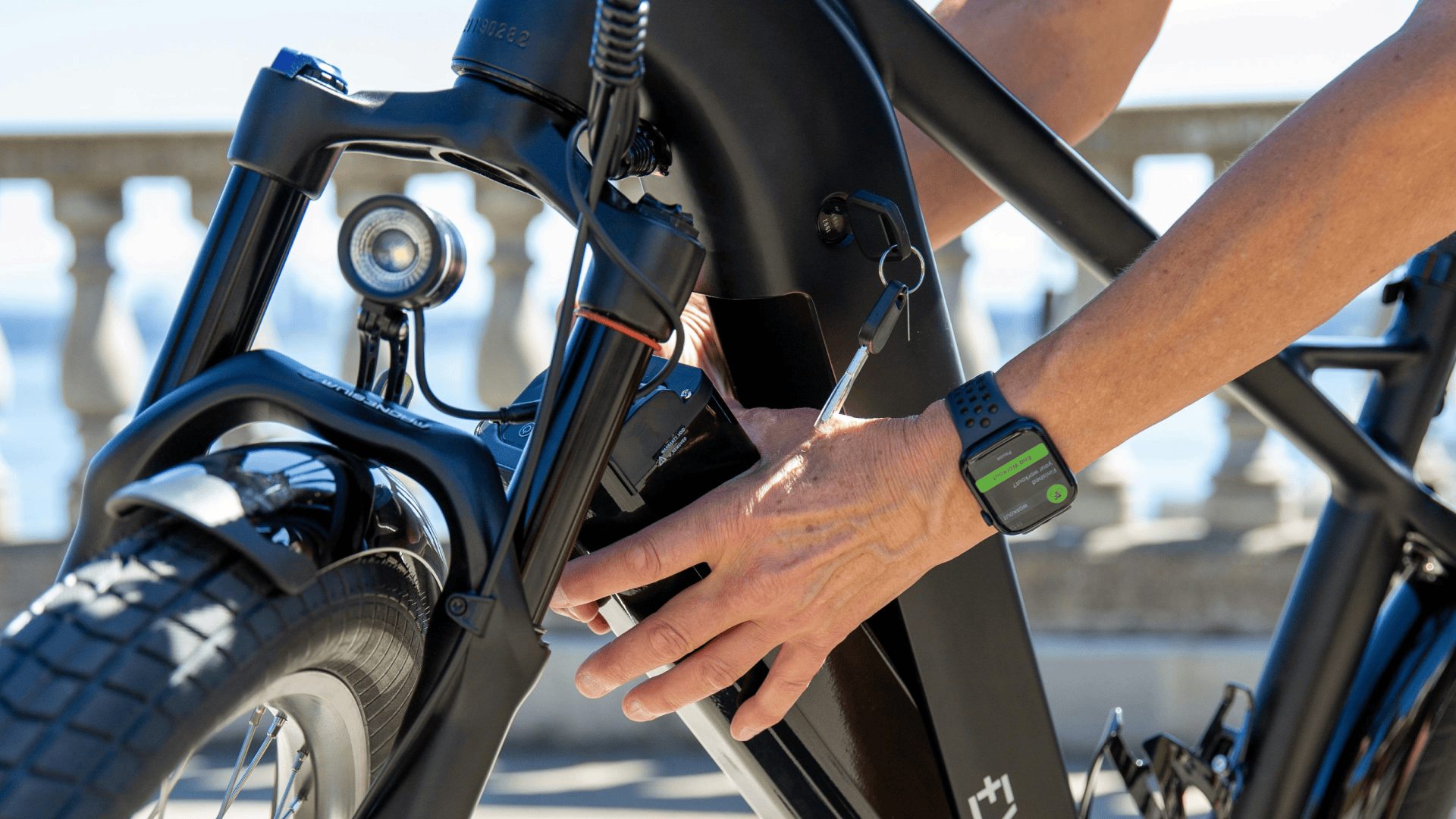
Use the built-in battery lock. Most quality e-bikes come with an integrated battery lock. Make sure you actually use it. It sounds obvious, but plenty of riders leave their battery unlocked out of habit. If your bike did not come with a battery lock, check if one is available as an aftermarket accessory from your manufacturer.
Do not leave your key in the lock. Another surprisingly common mistake. Some riders leave the battery key in the lock while riding for convenience. This defeats the purpose entirely.
Lock your bike to a sturdy fixed object like a bike rack, solid metal post or similar. A battery lock will not help much if someone can simply walk off with the whole bike. Always use a quality lock to secure the frame. Check the Sundays approved lock list for options that meet insurance requirements.
Consider a secondary cable through the battery. Some riders run a thin cable lock through the battery mount as an extra deterrent. It will not stop a determined thief with tools, but it adds time and visibility to any attempted theft.
Lithium-ion battery fires are the fastest-growing fire risk in New South Wales. Fire and Rescue NSW recorded 323 lithium-ion battery fires in 2024, up from 272 in 2023 and 165 in 2022, a 95% increase over just two years. E-bikes and e-scooters represent the single largest category of these incidents.
The risk comes from a phenomenon called thermal runaway: when a battery cell overheats, it triggers a chain reaction that generates intense heat and toxic fumes. These fires burn extremely hot, are very difficult to extinguish, and can reignite even after apparently being put out.
The good news is that the vast majority of battery fires involve cheap, non-compliant, or damaged batteries. If you are riding a quality e-bike from a reputable brand and following basic charging safety, your risk is low. But it is still worth taking seriously, especially given the new regulations.
Australian fire services across NSW, Queensland, Victoria, and South Australia all provide consistent guidance on safe e-bike charging:
Charge on hard, non-flammable surfaces. Concrete, tiles, or a garage floor. Never on carpet, bedding, or wooden decks. If something does go wrong, you want to minimise the chance of fire spreading.
Do not charge overnight or while you are out. This is the single most important rule. If a battery does fail during charging, you want to be awake and nearby to respond. Set a timer if it helps.
Keep the battery away from exits. If you charge in a hallway or near your front door, a battery fire could block your escape route. Charge in a garage, laundry, or well-ventilated area away from bedrooms and exit paths.
Only use the charger supplied with your e-bike. Using a third-party or incorrect charger is one of the leading causes of battery fires. Mismatched voltage or amperage can damage cells and trigger overheating. If your charger is lost or damaged, buy a genuine replacement from the manufacturer.
Do not charge a damaged battery. If your battery has been dropped, submerged in water, or shows any signs of swelling, cracking, or unusual heat, stop using it immediately. Contact your manufacturer or a specialist e-bike shop for advice.
Unplug when fully charged. Leaving a battery on charge indefinitely can stress the cells and reduce lifespan. Most modern chargers have auto-shutoff, but it is still good practice to disconnect once the indicator shows full.
If you live in an apartment, e-bike battery safety is particularly relevant. The combination of shared walls, limited ventilation, and restricted escape routes means that a battery fire in an apartment can be catastrophic, not just for you, but for your neighbours.
This is a live issue in Australia right now. Many strata committees across Sydney and Melbourne are reviewing their by-laws around e-bike storage and charging, with some considering outright bans on charging inside units. Insurance premiums for strata buildings are already rising, and the presence of e-bikes is becoming a factor.
If you live in a strata building:
Check your strata by-laws before charging inside your unit.
Ask your body corporate whether there is a designated charging area (some newer buildings are adding these).
If no designated area exists, charge in the most ventilated part of your unit, away from exits and living areas.
Never charge in common areas like hallways or stairwells without permission.
Consider investing in a lithium-ion fire blanket designed for battery fires. They are available from around $80 and can contain a fire while you evacuate.
From February 2026, NSW requires all e-bike batteries to be tested, certified, and marked before sale. Retailers face penalties of up to $825,000 for selling non-compliant products. An accompanying Information Standard (in effect since February 2025) means retailers must provide clear safety information about charging, storage, and disposal at the point of sale.
Other states are following suit. Energy Safe Victoria is consulting on similar frameworks, and Queensland Fire has increased its public safety campaigns around lithium-ion battery risks.
For riders, this means two things: firstly, new e-bikes and batteries purchased from reputable Australian retailers should meet safety standards. Secondly, if you bought a cheap e-bike or battery online from an overseas seller, there is a higher chance it may not meet these standards. If in doubt, have your battery inspected by a qualified e-bike technician.
Battery security technology is evolving fast. Here is what is available in 2026:
Bosch digital theft protection. Announced at CES 2026, Bosch's latest update allows owners to digitally flag stolen batteries and e-bikes through the eBike Flow app. Once flagged, the stolen component is visible across Bosch's entire dealer and service network, meaning a thief cannot easily get it serviced or registered to a new user. This is free for all Bosch Smart System users.
Bosch ConnectModule. For Bosch Smart System e-bikes, the ConnectModule is a GPS tracker that sits invisibly under the motor cover. Crucially, it has its own built-in battery, so it keeps transmitting location data even if the main e-bike battery is removed. It works with the eBike Flow app and can send movement alerts.
PowUnity BikeTrax. Compatible with Bosch, Shimano, Yamaha, Giant, and Brose motor systems, BikeTrax integrates inside the e-bike frame and uses 4G for real-time GPS tracking across 146 countries. It supports geofencing, so you will get an instant notification if your bike moves outside a set boundary.
Apple AirTag. The budget option. At around $50, an AirTag hidden in your frame or saddlebag can help locate a stolen bike through Apple's Find My network. However, since the AirTag tracks the bike's location, it will not help you find your battery if a thief removes only the battery and leaves the AirTag behind. It will not send real-time alerts like a dedicated GPS tracker, and it only works well in areas with other Apple devices nearby, but for the price, it is a worthwhile extra layer of security for the entire e-bike.
Knog Scout. An Australian-designed bike alarm and GPS tracker that uses Apple's Find My network. It attaches to your bike, sounds an alarm on movement, and lets you track location through your iPhone. It is a good middle ground between an AirTag and a full GPS, but like the AirTag, it is typically attached to the bike frame and won't help you locate your battery if it is stolen separately.
Looking after your battery is not just about security. Proper care also protects your investment by extending its useful life. A well-maintained lithium-ion battery should last between 500 and 1,000 charge cycles, or roughly three to five years of regular use.
Store between 20% and 80% charge when not in use for extended periods. Storing at full charge or completely flat accelerates cell degradation.
Avoid extreme temperatures. Do not leave your battery in direct sunlight, in a hot car, or outside overnight in winter. Lithium-ion cells perform best between 10 and 25 degrees Celsius.
Keep it dry. While most e-bike batteries are water-resistant, they are not waterproof. Avoid submerging or pressure-washing the battery area.
Remove the battery for long-term storage. If you are not riding for a few weeks, take the battery off the bike and store it indoors at around 50 to 60 percent charge.
If your battery is stolen despite your best efforts, specialist e-bike insurance can cover the replacement cost. Sundays e-bike insurance covers theft of both the bike and its components, including the battery, whether it is stolen from your home, locked up in public, or taken from a vehicle. Terms and conditions apply - See PDS.
Many home and contents policies now exclude coverage of e-bikes in totality. We suggest you make sure you read the PDS carefully to determine coverage under any home and contents policy. The higher excesses with a home and contents policy are also something that could make claiming for a battery prohibitive.
To be covered for theft, you will need to have used an approved lock. This applies to the bike as a whole.
Replacement batteries typically cost between $400 and $1,200 for mainstream brands. Premium systems from Bosch, Shimano, or Specialized can cost more. The price depends on the battery capacity (measured in watt-hours), the brand, and whether it is a proprietary design.
In most cases, yes, but check your strata by-laws first. Some buildings have introduced restrictions on e-bike charging inside units. Follow fire safety guidelines: charge on hard surfaces, away from exits, and only while you are home and awake. Never charge overnight.
While lithium-ion battery fires are increasing in Australia, they remain relatively uncommon when quality, compliant batteries and genuine chargers are used. The majority of incidents involve non-compliant, modified, or damaged batteries. Following basic charging safety significantly reduces your risk.
Most home and contents policies offer limited cover for e-bike components and often have low sub-limits. Specialist e-bike insurance from Sundays provides comprehensive cover for theft of your bike and its components, including the battery.
GPS trackers like the Bosch ConnectModule and PowUnity BikeTrax can track your e-bike location in real-time, even if the main battery is removed. More affordable options like Apple AirTags or the Knog Scout can also help locate stolen bikes. Bosch's 2026 digital flagging system adds another layer by making stolen components visible across its entire dealer network.
Fire and Rescue NSW: E-bike and e-scooter battery safety
fire.nsw.gov.au
NSW Government: New safety requirements for lithium-ion e-micromobility products
nsw.gov.au
Queensland Fire Department: Lithium-ion battery safety
fire.qld.gov.au
Bosch eBike Systems: Theft protection with the eBike Flow app
bosch-ebike.com


.png)
